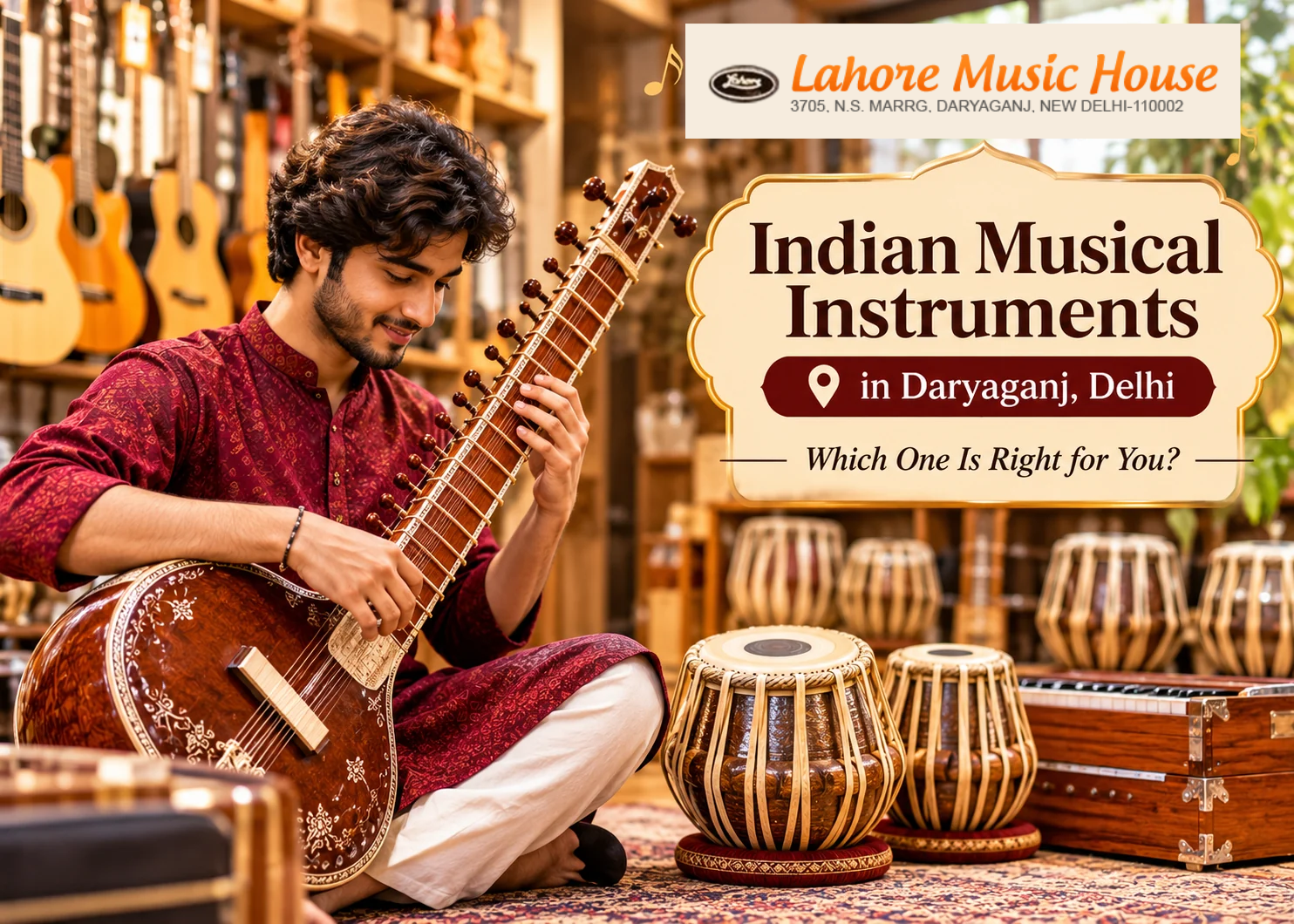
Ask any musician in Delhi where to look for Indian musical instruments in Daryaganj, and you’ll usually get a knowing smile. This corner of Old Delhi has been connected with classical music for a very long time. Our showroom at Lahore Music House has been part of that story since 1947.
But here’s what most beginners don’t tell you. The hard part isn’t finding instruments. It’s knowing which one fits you. A tabla and a sarod have almost nothing in common, and a harmonium suits a very different musician from a sitar.
So this isn’t a shopping checklist. Think of it as a friendly walk through the main Indian classical instruments and folk instruments, based on what we make and handle at our workshop.
Why the Instrument Family Matters First
Traditional Indian instruments fall into a few broad groups. Knowing which group excites you saves a lot of confusion later.
- Keyboard and reed: harmonium
- Stringed: sitar, sarod, sarangi, dilruba, esraj, rabab, violin
- Percussion: tabla, dholak, pakhawaj, naal, khol, bhangra dhol
- Drone and accompaniment: tanpura
- Small devotional and dance accessories: manjeera, ghungroo
Start by asking yourself one question. Do you want to sing, play a melody, or keep rhythm? Your answer narrows the list quickly.
For Singers and Devotional Music: The Harmonium and Tanpura
If you sing bhajans, ghazals or classical vocals, the harmonium is the instrument most people reach for. According to our catalogue, ours has multi-fold bellows, a seasoned Burma teak body and brass reeds, built for vocal accompaniment.
Pair it with a tanpura and you have what a serious riyaaz session needs: a steady drone to keep your pitch honest. We list an electronic tanpura with pitch fine-tuning, tempo control and dual battery or AC mode, which is handy for daily practice at home.
For Rhythm Lovers: Tabla, Dholak, Pakhawaj and More
Percussion is where Indian music really shows its range.
Tabla is the classic starting point for rhythm learners. Our professional tabla set is listed with a copper bayan and a sheesham dayan, and comes with rings, covers and a tuning hammer. Don’t underestimate that last item. You’ll use it often.
Dholak is a folk and celebration favourite. Ours is hand-carved from sheesham and mango wood, with either nut-bolt or traditional rope tuning.
Pakhawaj belongs to the Dhrupad tradition. It’s a solid wooden barrel drum with deep, grounded bass.
Then there’s the khol, a terracotta clay drum used in kirtan, and the naal, a bolt-tuned two-headed drum. If you love high-energy beats, the bhangra dhol is made from seasoned mango or sheesham wood with a leather bass head.
For Melody Seekers: The String Family
This is the group that gets people emotional.
The sitar is the best known. Our concert sitar is listed with a seasoned tun wood body, sympathetic tarafdar strings, a camel bone bridge and a padded case. It’s beautiful, but it’s also demanding. Be ready to practise patiently.
The sarod is fretless, with a polished steel fingerboard and a goatskin soundboard. The sarangi, according to our catalogue, is carved from a single block of seasoned red tun wood with a skin belly and gut strings. Many listeners find its sound close to the human voice.
Bowed instruments like the dilruba and esraj are less common, which is exactly why some students fall in love with them. Their sound is ethereal and different from the usual. If you prefer something more familiar, we also stock a violin and a Spanish guitar.
The Small Things That Complete a Performance
Don’t overlook the smaller items. Manjeera, the finger cymbals, are listed as heavy cast bell metal (kansa) and give a clear, sustained ring. Ghungroo, the Kathak dancing bells, are pure cast brass, tuned for rhythmic footwork. Dancers and devotional singers both rely on these.
What Separates a Good Instrument From an Average One
Whichever instrument you choose, a few things apply across the board.
Wood. Delhi swings between dry summers and humid monsoons, and unseasoned wood doesn’t cope well. At Lahore Music House, the website states the workshop uses aged sheesham, Burma teak and red tun wood, with stock seasoned for over five years.
Tuning. Our instruments are tuned by ear. They can be set to 440Hz concert pitch, or to a custom scale if you tell us in advance. Singers should always mention their preferred pitch.
Paperwork. You get a proper GST invoice, which matters for schools, academies and teachers buying in numbers.
Custom needs. Left-handed setups, engraving and special bridge settings are possible on request.
Not Based in Delhi?
You don’t need to be standing in Darya Ganj to explore our range. Send an enquiry through the website, and the team replies with a customised quote within 24 hours. Lahore Music House has also covered markets like the USA, UK, Germany, Mauritius, Australia and the West Indies, so shipping outside India isn’t new to us.
If you’d like help deciding where to begin, our guides on choosing a musical instrument shop in Daryaganj and a musical instruments shop near me in Delhi walk you through the visit itself.
Visit Us in Darya Ganj
Lahore Music House
Showroom No. 3705, Netaji Subhash Marg, Darya Ganj, New Delhi – 110002
(Next to Moti Mahal Restaurant)
Timings: Monday to Saturday, 10:30 AM to 8:00 PM
Phone / WhatsApp: +91-9891213939
A quick call before you come is always a good idea, especially if you have a specific instrument in mind.
Frequently Asked Questions
1. Which Indian musical instrument is best for a beginner?
2. Are all these Indian instruments available in Daryaganj?
Our catalogue lists harmonium, sitar, tabla, dholak, sarangi, sarod, tanpura, pakhawaj, naal, khol, esraj, dilruba, rabab, bhangra dhol, manjeera, ghungroo, violin and Spanish guitar. Call ahead to confirm stock of a particular piece.
3. Can I order a custom-tuned instrument?
Yes. The website mentions custom scale tuning, left-handed setups and engraving on request.
4. Do you ship outside Delhi?
Yes. You can enquire by phone, WhatsApp or the quote form, and the team will discuss delivery with you.
Final Thoughts
Indian musical instruments in Daryaganj offer something no online listing can: you hear them, hold them and compare them. Pick the family that matches your musical goal, test a few instruments, and trust your ears. If you’d like guidance, the Lahore Music House team is happy to help you find the right fit.