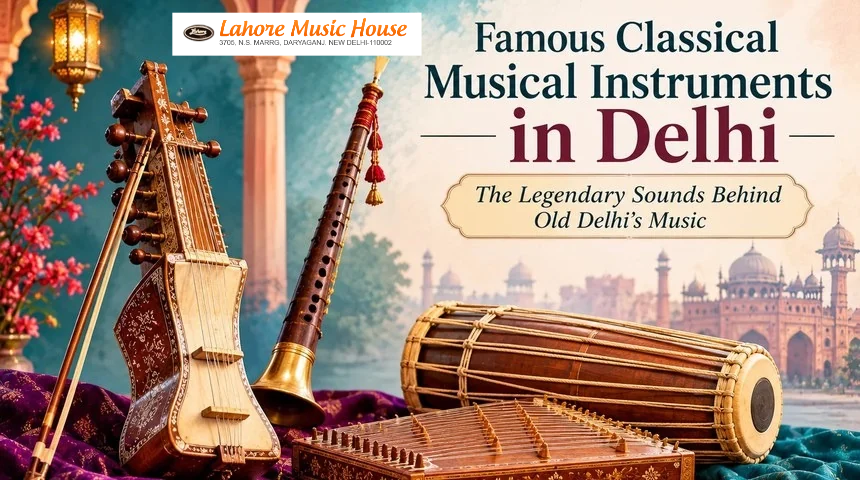
Walk through Old Delhi on a quiet evening and you might catch it: a faint tabla bol drifting from a upper-floor window, or the hum of a harmonium from a riyaaz room. Music has always lived here. It lives in homes, in shrines and in the lanes around Darya Ganj.
If you’ve been curious about the famous classical musical instruments in Delhi, this guide is for you. We won’t compare them like a catalogue. Instead, we’ll look at what makes each one famous: the sound, the tradition and the artists who carried it to the world.
What makes an instrument “famous” in Indian classical music?
Fame in Indian classical music usually comes from three things: a sound people recognise within one note, a deep link to a tradition like Dhrupad or Kathak, and great performers who made it known beyond India.
By that measure, a handful of famous Indian classical instruments stand out. Here they are.
1. The sitar: the sound the world knows
If one instrument represents Indian classical instruments abroad, it’s the sitar. Much of that fame goes to Pandit Ravi Shankar, whose concerts introduced the instrument to audiences across the world. That’s why you’ll still hear the phrase “Ravi Shankar sitar” in the trade.
What makes it special is the layered voice. Besides the main playing strings, the sitar has sympathetic strings (tarafdar) that ring on their own beneath the melody. Lahore Music House lists its concert sitar with a fully engraved seasoned tun wood body, tarafdar strings, a camel bone bridge and a padded case. The site also mentions the Vilayat Khan style, another well-known sitar school.
2. The tabla: Delhi’s rhythm is part of its identity
The tabla is a pair of drums: the smaller dayan and the larger bayan. Many people know it through Ustad Zakir Hussain, who made tabla familiar on international stages.
It also has a Delhi connection. The Delhi gharana is counted among the best-known tabla traditions, which is one reason a tabla set feels so at home in this city. The Lahore Music House tabla set has a heavyweight copper bayan, a sheesham dayan, rings, covers and a tuning hammer.
3. The harmonium: the voice’s closest companion
The harmonium didn’t begin in India, but it has become part of daily musical life here. You’ll find it at bhajan evenings, ghazal sittings, classical vocal lessons and school music rooms. It stays famous because it’s simple: pump the bellows, press the keys, and the note is there.
The website describes its handcrafted harmonium with multi-fold bellows, a seasoned Burma teak body and brass reeds. For anyone searching for a reliable harmonium shop in Delhi, the reed quality is what you’ll want to hear for yourself.
4. The sarod: the fretless voice
The sarod is plucked, fretless and played on a polished metal fingerboard, which lets the player glide between notes. Ustad Ali Akbar Khan is among its most celebrated names. The catalogue lists a concert sarod with a steel fingerboard, teak resonator, goatskin soundboard and coconut shell plectrum.
5. The sarangi: closest to the human voice
The sarangi is a bowed instrument often described as the nearest to a singing voice. Pandit Ram Narayan is widely credited with bringing it to the concert stage as a solo instrument. According to the site, its sarangi is carved from a single block of seasoned red tun wood, with a skin belly and gut strings.
6. The pakhawaj: the ancient drum of Dhrupad
Before the tabla became so common, the pakhawaj held the rhythm for Dhrupad, one of the oldest vocal forms in the tradition. It’s a barrel-shaped drum with a deep, rounded bass. The Lahore Music House version is a solid wooden barrel drum with thick hide straps.
7. The tanpura: the quiet instrument everyone depends on
The tanpura never plays a tune. It holds a steady drone so the singer or instrumentalist can stay in pitch. Many students today practise with an electronic version, and the catalogue lists an electronic tanpura with pitch fine-tuning and dual battery/AC mode.
Where to see famous classical instruments in Delhi
Old Delhi has been a base for musical instrument dealers in Delhi for generations. Lahore Music House, established in 1947, has served musicians, teachers and performing artists from its Darya Ganj showroom. Instruments are tuned by ear and can be set to 440Hz concert pitch or a custom scale on request.
You can visit at Showroom No. 3705 (next to Moti Mahal Restaurant), Netaji Subhash Marg, Darya Ganj, New Delhi – 110002, Monday to Saturday, 10:30 AM to 8:00 PM. Call or WhatsApp +91-9891213939 before you go.
Want to learn which instrument suits your own goals? Read our earlier guide on classical musical instruments in Delhi. To browse everything in one place, see the full instrument catalogue.
Frequently asked questions
Which is the most famous classical instrument in India?
The sitar and tabla are among the most widely recognised, both in India and abroad.
Where can I find traditional Indian instruments in Delhi?
Darya Ganj in Old Delhi is a well-known area. Lahore Music House is located there.
Can I order from outside Delhi?
Yes. The website says you can enquire via phone, WhatsApp or the quote form, and it offers export dispatch with protective crating.
Final thoughts
Every one of these famous classical musical instruments in Delhi carries a story. Hearing them in person is very different from hearing a recording. Visit Lahore Music House in Darya Ganj, listen, and let your ears decide.